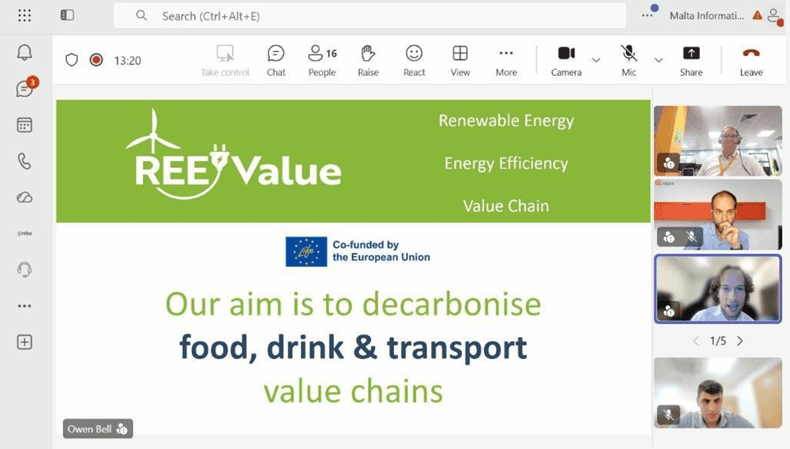
The EnR Transport Working Group, consisting of European energy agencies, research organisations, and transport experts, met to discuss freight transport and logistics decarbonisation. As part of REEValue’s efforts in expanding outreach through international stakeholders meetings; EWA and MBB were invited to the working group to present findings from the REEValue project with a particular focus on sustainable transport.
The presentation given by MBB Projects Executive Owen Bell, gave an introduction to the REEValue LIFE project, namely, the objective of generating value-chain collaborations amongst businesses in target NACE codes, through implementation of energy efficiency (EE) and renewable energy (RES) opportunities. Given the context of the Working Group, discussions focused strongly on transport as an immediate opportunity for short-term impact due to relatively low-cost and high-return operational adjustments.
Key points included:
– Route optimisation and improved vehicle loading.
– Eco-driving training and fuel consumption monitoring.
– Tire pressure management and maintenance.
– Gradual fleet electrification.
Despite opportunities, recurring barriers to freight decarbonisation within the food and beverage value chain context include:
– Fragmented financial support for EV uptake and lack of harmonized emissions reporting across the industry.
– SME technical capacity constraints and hesitation among competitors to collaborate, which inhibits route sharing and delivery optimisation in shared routes among competitors.
– Infrastructure & Space: Limited charging infrastructure and restricted depot space.
Moreover, a limited understanding of available financial incentives, especially due to the constant rolling deadlines for such incentives, make it challenging for SMEs to grasp the opportunities available to them. REEValue addresses this by aggregating country-specific funding opportunities for participating Member States through the online platform. The platform also estimates a company’s carbon footprint, recommending high-ROI energy and transport investments.
The second contribution came from Smart Freight Centre, who correctly argue that inconsistent emissions reporting methodologies currently generate non-comparable data across transport modes and countries. To establish a common standard, the Smart Freight Centre presented the Global Logistics Emissions Council (GLEC) Framework, which aligns with ISO 14083.
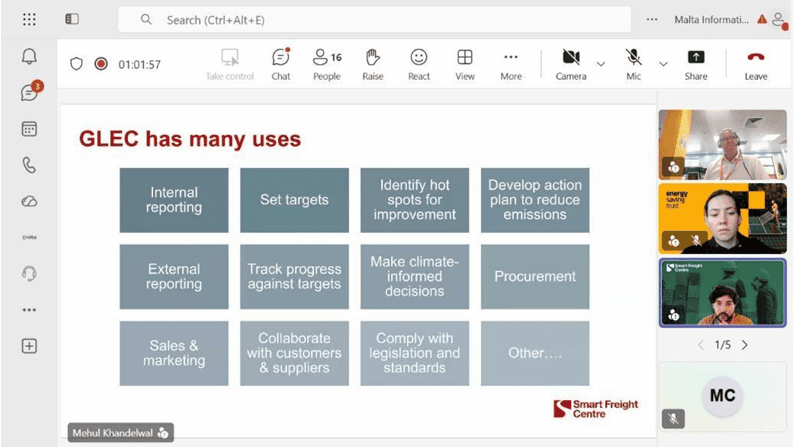
The GLEC methodology utilises consistent activity data and emission factors to support:
– Comparable carbon reporting and supply chain transparency.
– Climate-informed procurement and operational optimization.
– Regulatory compliance.
The final presentation came from a UK-based organisation, Energy Saving Trust, which shared practical strategies for accelerating heavy-duty vehicle decarbonization through large-scale demonstrations of zero-emission Heavy Goods Vehicles (ZEHGVs) and depot charging infrastructure. Findings from the UK indicate that successful infrastructure projects often pair fleet procurement with integrated solutions like solar power and smart management, with up to 70% grant funding available and operators increasingly sharing facilities to maximize efficiency across complementary schedules.
– Immediate Gains: While vehicle electrification expands, massive emissions savings are immediately available through logistics management and operational best practices.
– Beyond technology, de-fragmenting financial data, providing technical guidance, and standardising frameworks like GLEC and ISO 14083 are crucial for driving widespread emission-tracking adoption, especially among resource-constrained SMEs.
For more information or assistance, please connect with us on LinkedIn REEValue or follow us on Twitter